Sampled Distributions
Because plotting all the outcomes of a process on a graph would be very time consuming, we usually sample the outcomes of an experiment.
It then becomes convenient to use a statistical representation of the summary to describe the sampled distribution. The most common of these summary statistics are:
- The mean value of the distribution
- The standard deviation of the distribution
If we know the mean and the standard deviation, we can completely describe a normal distribution mathematically.
However, because not all distributions are symmetrical, there may also be a need to measure the extent to which variations from the mean in one direction are more likely than the other in order to describe the distribution mathematically.
Mean Value
The mean value (traditionally represented by the symbol m) is a measure of the central tendency of the distribution and is more or less synonymous with the more colloquial terms average and expected value. The mean is calculated as follows:
where:

|
is the mean |
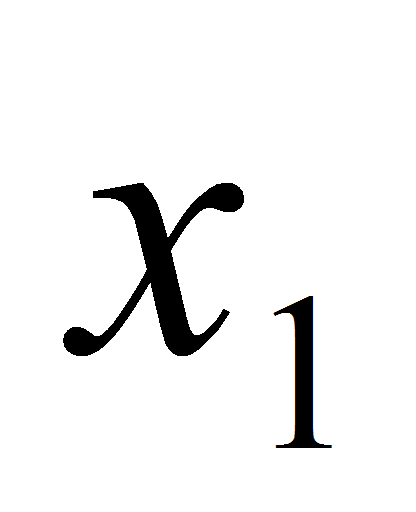 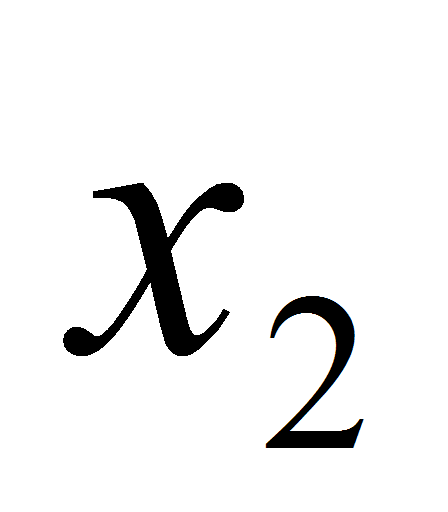
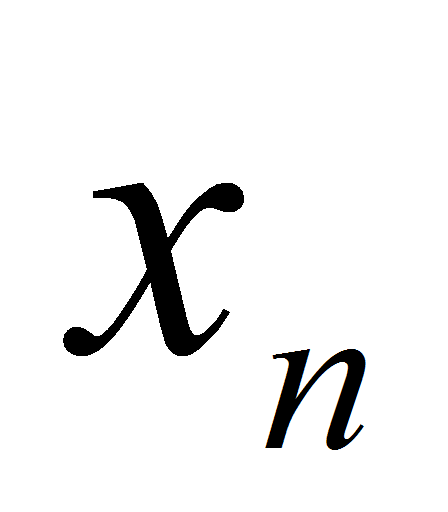
|
are outcomes |
| n | is the total number of outcomes |
For probability distributions based on sampling, the mean is considered to be the most reliable statistical indicator of the central tendency because it takes into account all the outcomes sampled.
Standard Deviation
The standard deviation (traditionally represented by the symbol s) measures the amount of variation within the distribution around the mean value
The standard deviation is calculated by first estimating the variance of the distribution according to the following formula:

where:
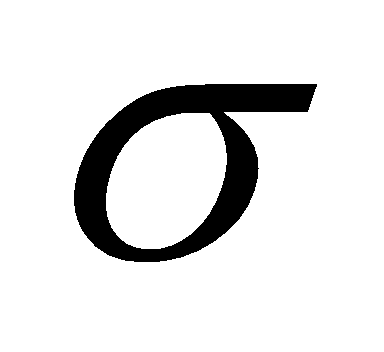
|
is the standard deviation |
|
|
are outcomes |
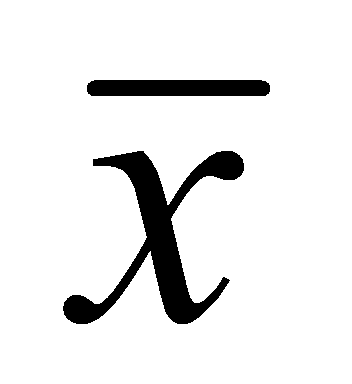
|
is the sampled mean value |
The square root of the variance is then taken to find the standard deviation for the distribution.
Normal Distribution
The following equation describes a normal distribution:
where:
- ¦ is the frequency
- m is the mean
- s is the standard deviation
Note that the value of ¦ peaks when x equals m and declines symmetrically as x moves away from m in either direction. The rate at which ¦ declines depends on the parameter s.
Note also that the value of ¦ never quite reaches zero. This means than no value of x is an absolutely impossible outcome for any true normal distribution. In practical work, however, it is common practice to truncate the tails of a normal distribution.
Example
Assume that ten students taking a math test receive the following scores: 64, 69, 71, 73, 73, 75, 82, 82, 82, 89.
- First calculate the mean:
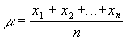

- Now, using the calculated mean of 76, evaluate the following equation.
Each expression in the calculation is calculated as in the following example:

The total equation evaluates as follows:

- Then, take the square root of 54.1
