Combining Probabilities
In addition to enabling us to analyze a single process, probability theory also provides the analytical tools to combine probability distributions in ways appropriate to specific circumstances.
If the activities follow each other (as in the case of a finish-to-start relationship), the mean durations and the variances are both additive. However, this is not the case if the two activities must be performed in parallel. Under this type of circumstance, we must look for the distribution of the greater of two uniformly distributed durations.
Because project networks generally comprise a multitude of activities that are partly in series and partly parallel, the analytical approach to calculating probability is impractical. Instead, a technique known as Monte Carlo simulation is the only practical approach.
Example 1
Assume a project consisting of two activities with a finish-to-start relationship:

Suppose that both activities are expected to have a duration between 1 and 6 days, and that any number of days between 1 and 6 is equally likely. The mean or "expected" duration of each activity is, therefore, 3.5 days.
We can calculate that the mean duration for the whole project is 7 days by adding the mean durations of the individual activities together. Mean durations are additive in this case.
It also turns out that variances are additive in this case. The variance of the distribution of each duration is approximately 2.9, and so the variance of the total project is 5.8. By taking the square root of the total project variance, we arrive at the standard deviation, about 2.4 in this case.
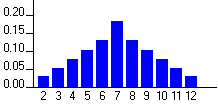
When we graph the duration probability of the overall project duration, we see that we get the same triangular distribution shape we get when we roll a pair of dice and add the two numbers:
Example 2
Now, suppose that the same two activities must be performed in parallel:

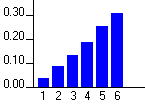
This time, the overall project completion is dependent on both activities being completed. In other words, we are looking for the distribution of the greater of two uniformly distributed durations.
Now, when we graph the duration probability of the overall project duration, we get the following shape: