More About Standard Deviation
The standard deviation is the square root of the average of the squares of the individual deviations from the mean value.
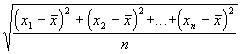
For this reason, the standard deviation is sometimes referred to as the root mean square (RMS) deviation. Notice that one result of this squaring is that the standard deviation measures the degree of variation without regard for the direction in which the variation occurs.
Still, the standard deviation of a probability distribution is a very useful value to know. Roughly speaking, there is about a 68% chance of any particular outcome falling within one standard deviation of the mean value and about a 99% chance of the outcome falling within three standard deviations of the mean. This variation can occur in either direction from the mean and is usually referred to as a 99% confidence interval.
Example
The mean temperature for Houston, Texas, during the month of August at 5 PM is 93 degrees Fahrenheit with a standard deviation of 3.5 degrees. Based on three standard deviations (that is, ± 10.5 degrees), then it is almost (99%) certain that the 5 PM temperature in Houston on any given day in August will fall between 82.5 and 103.5 degrees Fahrenheit.